
Which Courses Should I Take?
Aim high. The Math Department recommends that you consider enrolling in as advanced a course as you might be prepared for, rather than repeat material, even if you do not have university credit for something. If you find yourself in over your head, you can drop back to a more elementary course: the registrar’s office allows dropbacks (https://registrar.rice.edu/students/dropback, see also below) for several of our courses, as late as week 7 of the semester.
Note. If you know the material for a course but do not officially have credit, know that it might be possible to skip it even if your major requires the course. Many departments allow you to skip a basic math requirement and take another math class in its place (e.g., a major requires 101 and 102, but you take 102 and 212). Consult with your department before registering to understand its particular policies and requirements.
Transfer credit from another university. Consult with Prof. Orcan-Ekmekci.
Single Variable Calculus
| Course | Some follow-up courses |
| Math 101 – Single Variable Calculus I | Math 102 |
| Math 102 – Single Variable Calculus II | Math 211, 212, 355 |
We also offer an alternative sequence, not intended for science or engineering majors, covering the material in Math 101, but at a slower pace, while emphasizing problem solving:
| Course | Some follow-up courses |
| Math 111 – Calculus: Differentiation (Fall only) | Math 112 or 101 |
| Math 112 – Calculus: Integration (Spring only) | Math 102 |
If you wish to register for Math 101 or Math 111, you must first take the pre-calculus diagnostic exam.
| Course |
| Math 110 – Math Discussion Sessions |
This is a 1-hour supplemental course which reviews pre-calculus concepts needed in calculus. It is required for MATH 111 students, and optional for MATH 101 students who may benefit from a little pre-calculus review.
| No calculus background | Calculus AP Grade of 4/5 on AB or suitable IB Mathematics (HL) or A-level score or Rice exam credit: | Calculus AP Grade of 4/5 on BC or suitable IB Mathematics (HL) or A-level score: |
| Start with Math 101 or 111 | Credit for Math 101 equivalent | Credit for Math 101-102 equivalent |
Distribution credit course for non-science/engineering students
| Course |
| Math 115 – The Art of Mathematics (Spring only) |
This course is intended for non-science/engineering students who don’t need to take calculus, but want to learn more about aspects of mathematical ideas and thinking that don’t require a lot of algebraic formulas.
Linear Algebra
If you have good knowledge of single variable calculus, you should strongly consider taking linear algebra in your first year. It is key for data science, many STEM majors require it, and it unlocks several math courses.
| Course | Some follow-up courses |
| Math 355 – Linear Algebra (no harder than 200-level!) | Math 211, 302, 368 |
| Math 354 – Honors Linear Algebra (no harder than 200-level!) | Math 220, 232, 321/331, 356 |
Ordinary Differential Equations
| Course | Some follow-up courses |
| Math 211 – Ordinary Differential Equations | Math 302, 355, 381 |
| Math 220 – Honors Ordinary Differential Equations (Fall only) | Math 232, 354 |
Multivariable Calculus
From least to most advanced:
| Course | Some follow-up courses |
| Math 212 – Multivariable Calculus | Math 302, 355, 382 |
| Math 232 – Honors Multivariable Calculus (Spring only) [1] | Math 220, 321/331, 356 |
| Math 221 & 222 – Honors Calculus III & IV (Fall-Spring) [2] | Math 220, 321/331, 356 |
[1] Math 232 is an honors treatment of differential calculus in Rn, some integral calculus in Rn, and Green’s, Gauss’s, and Stokes’s theorems in R2 and R3. Knowledge of linear algebra is required, ideally, at the Math 354 level. Math 220 is also allowed but does not cover every necessary theorem and concept. Math 355 is allowed too but, as it is not Honors-level, you must catch up on proof-writing and take Math 290 with 232.
[2] Math 221 & 222 is a year-long honors treatment of linear and multilinear algebra, differential and integral calculus in Rn, and the generalized Stokes theorem for submanifolds of Rn with differential forms. It is our most advanced offering of multivariable calculus, meant for students wanting to study pure mathematics. If, after Math 221, you do not wish to continue with Math 222, you can take Math 232 instead.
What is an “Honors” course?
Honors courses emphasize theory and mathematical proof-writing. Students should consider honors courses if they have a strong math background and are considering a major in an area with a substantial math component or enjoy a challenge and want to go beyond just learning to solve computational problems.
Proof-writing
The formal language of mathematics is one of mathematical proofs. Every student who studies mathematics should take a course which prepares them to read and write proofs. Several of our courses introduce students to proofs; among them are any of the honors courses, as well as Math 302, which can be taken later.
| Course |
| Math 290 – Mathematical Writing Seminar |
Students enrolling in their first proofs course should consider concurrently enrolling in Math 290, a 1-credit, half-semester course that provides additional targeted feedback on students' mathematical writing. Contact the Math 290 instructor for more information and for registration.
Analysis and Algebra
Real analysis is the study of functions on the real line. It closely examines the properties of the real line and gives rigorous justifications for all of the results that one takes for granted when learning calculus. Abstract Algebra studies abstract algebraic structures such as groups, rings, and fields, which model algebraic operations such as addition and multiplication. Both subjects are at the core of higher mathematics and are strongly encouraged for all students.
Introductory analysis courses are Math 302 and Math 321. Students who already have familiarity with proofs are able to skip Math 302 and enroll in Math 321. Students who wish to take an honors analysis course should consider taking Math 331. These courses are only offered in the fall, except Math 302, which is also offered in the spring. Possible continuations to Math 321 or Math 331 include Math 322 or Math 370.
The introductory algebra course is Math 356; it is offered in the fall. Math 357 (Algebra II) is a continuation of Math 356 in the spring semester, but one can take Math 356 without committing to taking Math 357. However, taking just Math 356 will not give a sense of the full scope and power of abstract algebra.
Other electives and higher level courses
There are many other 300- and 400-level electives offered. Some of them are advanced and should only be taken after one has had courses that provide preparation for writing proofs. Some involve almost no proof-writing whatsoever, and can often be taken by students who just have Math 211 and/or Math 212 as preparation. Some fall in the middle, and might vary from year to year.
Email us at math@rice.edu or go to the course catalog for more information
The following table is a rough categorization of some of the electives offered, although students should check with the individual instructors to be sure about what level each course will be offered at.
| Course | Semester (usually) |
| Few/No Proofs Involved | |
| Intro to PDEs – Math 381 (Fall) | Fall |
| Computational Complex Analysis – Math 382 (Spring) | Spring |
| Some Proofs Involved (varies) | |
| Elements of Knot Theory – Math 304 | Varies |
| Number Theory – Math 365 | Spring |
| Geometry – Math 366 | Varies |
| Combinatorics – Math 368 | Varies |
| Advanced Electives | |
| Calculus on Manifolds – Math 370 | Spring |
| Representation Theory – Math 374 | Fall |
| Curves and Surfaces – Math 401 | Spring |
| Probability Theory – Math 412 | Varies |
| Topology – Math 443 | Spring |
| PDEs – Math 423 | Fall |
| Integration Theory – Math 425 | Fall |
| Complex Analysis – Math 427 | Spring |
| Differentiable Manifolds – Math 451 | Spring |
See the course catalog for descriptions of these courses.
Dropback options
Students may drop back from a more advanced math class to a less advanced one at any point in the first seven weeks of the semester, per the chart below. Contact your instructor or a math advisor for more information.
| From | To |
| Math 101 – Calculus I | Math 111 – Calculus: Differentiation & Math 110 – Math Discussion Sessions |
| Math 101 – Calculus I | Math 112 – Calculus: Integration |
| Math 102 – Calculus II | Math 101 – Calculus I |
| Math 211 – Differential Equations | Math 102 – Calculus II |
| Math 212 – Multivariable Calculus | Math 102 – Calculus II |
| Math 220 – Honors Diff. Eqns | Math 211 – Differential Equations |
| Math 354 – Honors Linear Algebra | Math 355 – Linear Algebra |
| Math 232 – Honors Multivariable Calculus | Math 212 – Multivariable Calculus |
| Math 221 – Honors Calculus III | Math 220 – Honors Diff. Eqns |
| Math 221 – Honors Calculus III | Math 212 – Multivariable Calculus |
| Math 221 – Honors Calculus III | Math 211 – Differential Equations |
| Math 222 – Honors Calculus IV | Math 232 – Honors Multivariable Calculus |
| Math 222 – Honors Calculus IV | Math 212 – Multivariable Calculus |
| Math 321 – Intro to Analysis I | Math 302 – Elements of Analysis |
| Math 331 – Honors Analysis | Math 321 – Intro to Analysis I |
Helpful links
Useful courses for students interested in math education, computer science, or economics/finance
Contact Information
Tel (713) 348-4829
Mailing Address:
Rice University
Math Department -- MS 136
P.O. Box 1892
Houston, TX 77005-1892
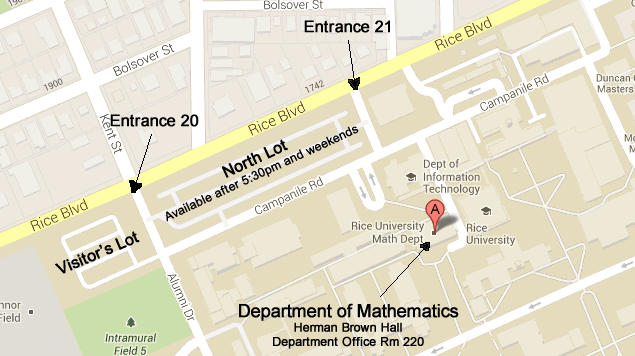
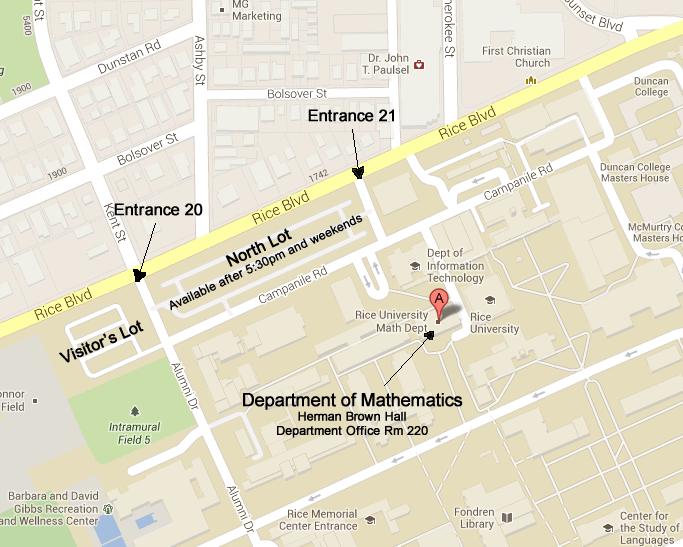
Physical Address:
Rice University
Herman Brown Hall for Mathematical Sciences
6100 Main Street
Houston, TX 77005